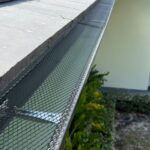
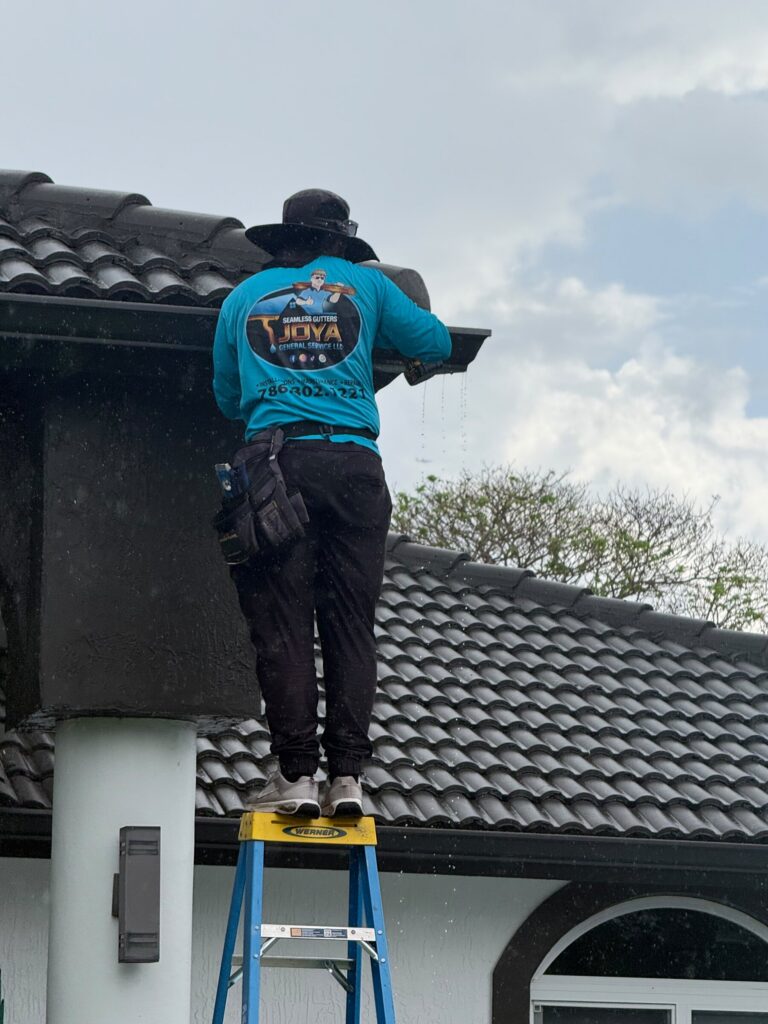
Most homes in South Florida are fitted with 5-inch K-style gutter, and on a typical single-storey roof that is the right call. The decision that actually matters is rarely the shape. It is the capacity, the thickness of the metal, and how the run is hung on the fascia — and those three are what separate a gutter that survives a hurricane season from one that comes off the house in August.
Here is how we size a job when we come out to look at it.
Start with the roof, not the house
A gutter is sized by how much water reaches it, and that depends on three things: the area of roof draining into that run, how steep the roof is, and how hard it rains where you live.
The first two are measurable on site. The third is the one homeowners underestimate. A South Florida afternoon storm can drop two inches of rain in an hour. Guttering specified for average rainfall will carry that for about ten minutes and then overshoot the front edge in a sheet — which is the moment people call us, usually while standing at a window watching it happen.
A steep roof makes it worse. Water arrives at the eave faster and with more momentum, so some of it skips the gutter entirely rather than dropping into it. On a steep slope we either go up a size or move the run slightly out and down to catch the throw.
Five-inch or six-inch
Six-inch K-style carries roughly 40 percent more water than 5-inch, for a difference in price that is small next to the cost of replacing soffit. We recommend it when:
- The catchment area draining into one run is large — long roof planes, or several planes feeding one valley.
- The roof is steep, or it is metal, which sheds faster than shingle or tile.
- There is nowhere sensible to add another downspout, so the existing one has to do more work.
- The run already overflows and the gutter itself is otherwise sound.
Six-inch gutter also pairs with a 3×4 downspout instead of the standard 2×3, and that is often the real fix. The gutter was never the bottleneck; the outlet was.
Seamless is worth it here
Sectional gutter comes in lengths and is joined every few feet. Every joint is a seam, every seam is sealed, and every sealant joint has a service life shorter than the metal around it. In a climate that cycles between heavy rain and hard sun, those joints are the first thing to fail.
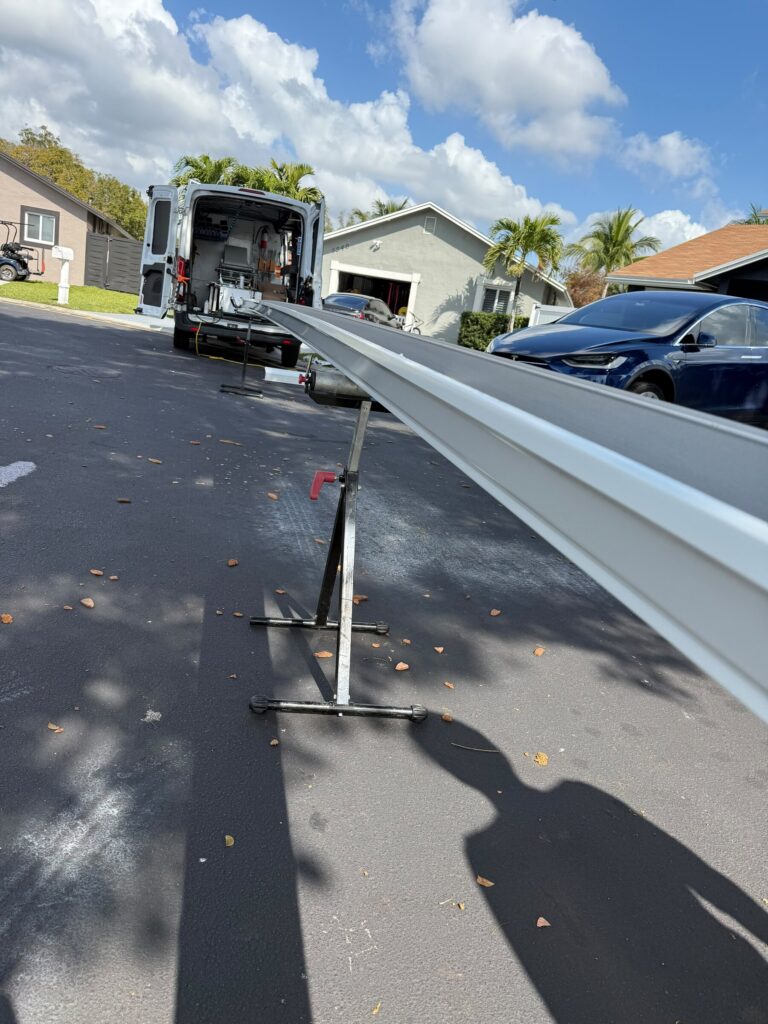
Seamless gutter is formed on site. The machine rolls a coil of aluminium into a continuous length cut to the exact measurement of your run, so the only joints in the whole system are at the corners and the outlets. Fewer joints, fewer leaks, and no visible line every ten feet across the front of the house.
That is the standard we install. It is not an upgrade we sell — it is what we bring on the truck.
Thickness is the spec nobody quotes
Aluminium gutter is commonly offered in .027 inch and .032 inch. The thinner one is cheaper and it dents — a ladder set against it, a branch, a hailstone. The thicker one holds its shape, holds a hanger screw better, and stands up to being walked past by a lawn crew every week.
If you are comparing two quotes and one is noticeably cheaper, the gauge is the first place to look. The second is the hangers.
Watch the hangers
Spikes driven through the gutter into the fascia work loose. They loosen faster in wood that has already been wet, which describes a lot of fascia board in Miami-Dade and Broward. Once one lets go the run sags, water pools at the low point instead of running to the outlet, and the sag gets worse under the weight.
Hidden hangers screwed into the fascia every two feet hold the line straight through a storm season, carry the load across more points, and are invisible from the ground. On exposed elevations and anywhere the run is long, we tighten that spacing.
The fall is not optional
A run has to drop about a quarter of an inch for every ten feet of length so that water moves towards the outlet instead of standing in the trough. Standing water is what breeds mosquitoes, grows the dark streaks you can see from the street, and adds weight the hangers were not sized for.
It should not be visible from the ground. If you can see your gutter sloping, it is sloping too much — and if water sits in it after the rain stops, it is not sloping enough.
What we do when we come out
We measure each run, count the roof planes feeding it, look at the fascia behind the existing gutter, and tell you whether what you have needs replacing or only resealing and rehanging. Sometimes the answer is that your gutter is fine and the problem is a downspout discharging two feet from the wall.
There is no charge for looking, and we will tell you when the cheaper repair is the right one.
Joya General Services Gutter LLC installs seamless aluminium guttering across Opa-locka, Miami and Fort Lauderdale. Call (786) 302-1221 for a free measured quote.