
Tag: Guttering

  • How to Choose the Right Guttering for Your Home

    How to Choose the Right Guttering for Your Home

    Most homes in South Florida are fitted with 5-inch K-style gutter, and on a typical single-storey roof that is the right call. The decision that actually matters is rarely the shape. It is the capacity, the thickness of the metal, and how the run is hung on the fascia — and those three are what separate a gutter that survives a hurricane season from one that comes off the house in August.

    Here is how we size a job when we come out to look at it.

    Start with the roof, not the house

    A gutter is sized by how much water reaches it, and that depends on three things: the area of roof draining into that run, how steep the roof is, and how hard it rains where you live.

    The first two are measurable on site. The third is the one homeowners underestimate. A South Florida afternoon storm can drop two inches of rain in an hour. Guttering specified for average rainfall will carry that for about ten minutes and then overshoot the front edge in a sheet — which is the moment people call us, usually while standing at a window watching it happen.

    A steep roof makes it worse. Water arrives at the eave faster and with more momentum, so some of it skips the gutter entirely rather than dropping into it. On a steep slope we either go up a size or move the run slightly out and down to catch the throw.

    Five-inch or six-inch

    Six-inch K-style carries roughly 40 percent more water than 5-inch, for a difference in price that is small next to the cost of replacing soffit. We recommend it when:

    • The catchment area draining into one run is large — long roof planes, or several planes feeding one valley.
    • The roof is steep, or it is metal, which sheds faster than shingle or tile.
    • There is nowhere sensible to add another downspout, so the existing one has to do more work.
    • The run already overflows and the gutter itself is otherwise sound.

    Six-inch gutter also pairs with a 3×4 downspout instead of the standard 2×3, and that is often the real fix. The gutter was never the bottleneck; the outlet was.

    Seamless is worth it here

    Sectional gutter comes in lengths and is joined every few feet. Every joint is a seam, every seam is sealed, and every sealant joint has a service life shorter than the metal around it. In a climate that cycles between heavy rain and hard sun, those joints are the first thing to fail.

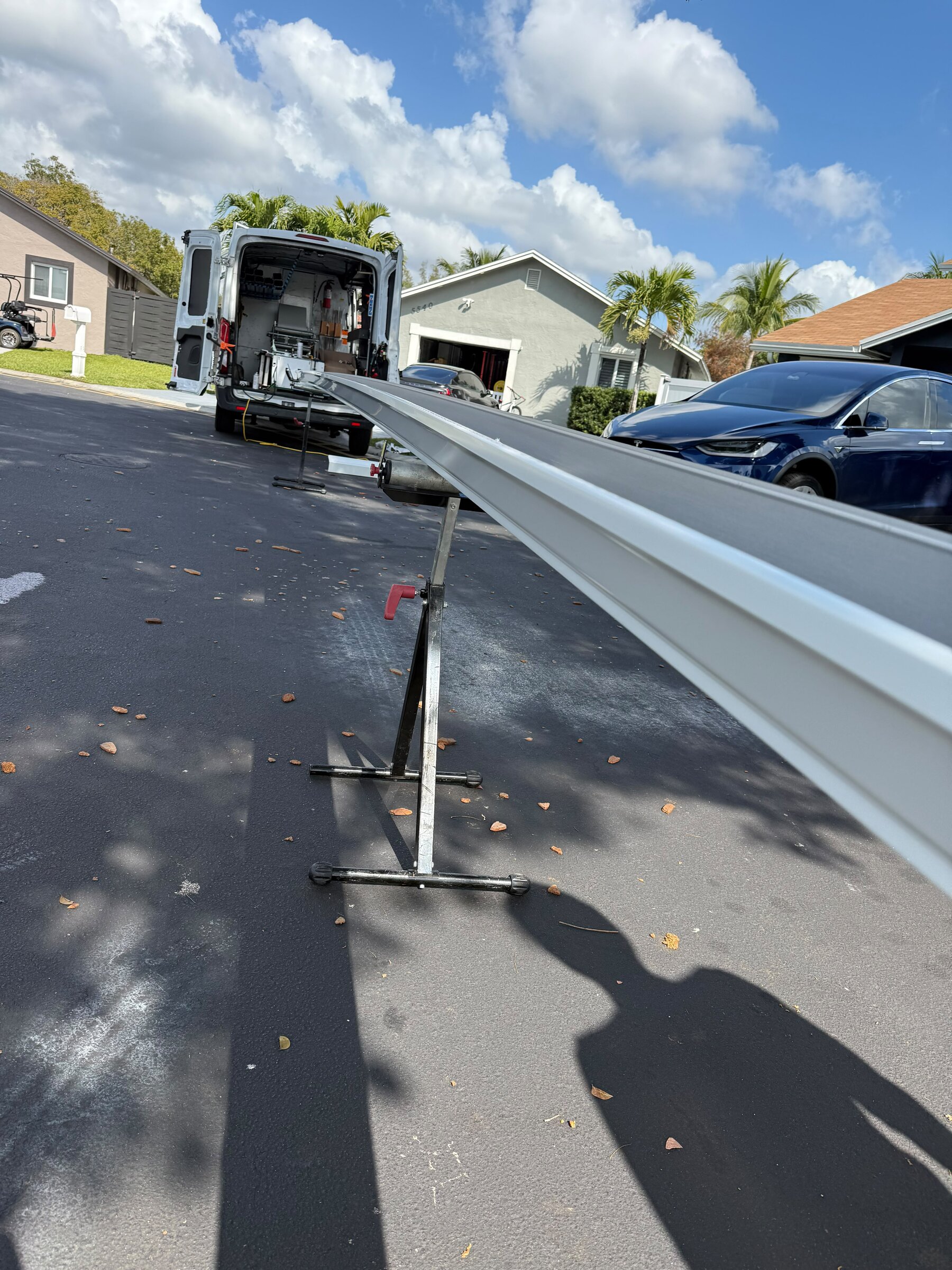
    Seamless gutter is formed on site. The machine rolls a coil of aluminium into a continuous length cut to the exact measurement of your run, so the only joints in the whole system are at the corners and the outlets. Fewer joints, fewer leaks, and no visible line every ten feet across the front of the house.

    That is the standard we install. It is not an upgrade we sell — it is what we bring on the truck.

    Thickness is the spec nobody quotes

    Aluminium gutter is commonly offered in .027 inch and .032 inch. The thinner one is cheaper and it dents — a ladder set against it, a branch, a hailstone. The thicker one holds its shape, holds a hanger screw better, and stands up to being walked past by a lawn crew every week.

    If you are comparing two quotes and one is noticeably cheaper, the gauge is the first place to look. The second is the hangers.

    Watch the hangers

    Spikes driven through the gutter into the fascia work loose. They loosen faster in wood that has already been wet, which describes a lot of fascia board in Miami-Dade and Broward. Once one lets go the run sags, water pools at the low point instead of running to the outlet, and the sag gets worse under the weight.

    Hidden hangers screwed into the fascia every two feet hold the line straight through a storm season, carry the load across more points, and are invisible from the ground. On exposed elevations and anywhere the run is long, we tighten that spacing.

    The fall is not optional

    A run has to drop about a quarter of an inch for every ten feet of length so that water moves towards the outlet instead of standing in the trough. Standing water is what breeds mosquitoes, grows the dark streaks you can see from the street, and adds weight the hangers were not sized for.

    It should not be visible from the ground. If you can see your gutter sloping, it is sloping too much — and if water sits in it after the rain stops, it is not sloping enough.

    What we do when we come out

    We measure each run, count the roof planes feeding it, look at the fascia behind the existing gutter, and tell you whether what you have needs replacing or only resealing and rehanging. Sometimes the answer is that your gutter is fine and the problem is a downspout discharging two feet from the wall.

    There is no charge for looking, and we will tell you when the cheaper repair is the right one.

    Joya General Services Gutter LLC installs seamless aluminium guttering across Opa-locka, Miami and Fort Lauderdale. Call (786) 302-1221 for a free measured quote.
  • What a Gutter Inspection Actually Checks

    What a Gutter Inspection Actually Checks

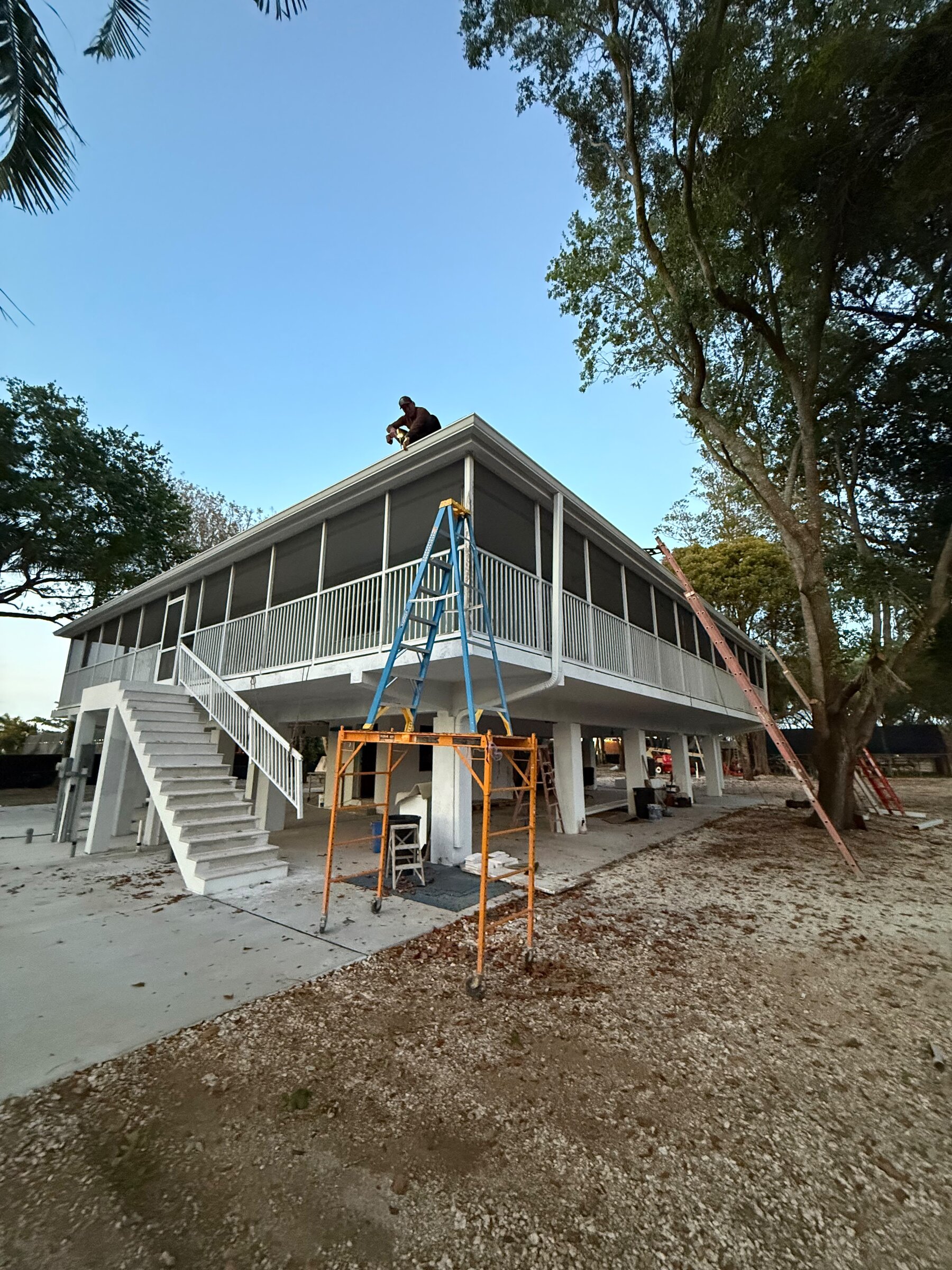
    A proper look at a gutter system takes about twenty minutes and covers six things. It is done from a ladder, not from the driveway. If someone quotes you a replacement without going up, they are guessing — and guessing always comes out at “you need a whole new system”.

    This is what we check, in the order we check it, so you know what a real inspection looks like and can tell when you are not getting one.

    1. The fall

    A run should drop about a quarter of an inch for every ten feet so water moves to the outlet instead of standing in the trough.

    We check it with a level and, better, with water. Standing water after rain means the fall is wrong or a hanger has let go and the run is sagging. Water sitting in a gutter breeds mosquitoes, adds weight the hangers were not sized for, and leaves the dark tide line you can see from the street.

    2. The hangers and the fascia behind them

    We check how the run is attached and what it is attached to. Spikes work loose over time, especially in fascia that has been wet. Hidden hangers should be in at about two-foot spacing, tighter on long or exposed runs.

    Then we check the board itself. A screw is only as good as the wood holding it, and soft fascia is the single most common thing that turns a repair into a bigger job. We press along the board behind the gutter — if it gives, you need carpentry before you need guttering, and we will say so.

    3. The seams and the sealant

    On a sectional system, every joint gets checked. Sealant has a service life considerably shorter than the metal it is sealing, and in this climate it cracks, shrinks and lifts at the edges.

    On a seamless system there are only corners and outlets to check, which is the point of fitting it. Corners are still the place to look: they take the most movement and they are where almost every seamless leak we find turns out to be.

    4. The outlets and the downspouts

    We count the outlets against the length of the run and the roof area feeding it, and we check the size of what is fitted — 2×3 or 3×4.

    Then we check whether they are clear. The usual blockage is not in the gutter at all; it is in the elbow at the top of the downspout, where the pipe turns and debris stops moving. We flush it and listen. A downspout that gurgles or knocks in heavy rain is telling you there is a restriction in it.

    5. Where the water goes after the downspout

    This is the step most often skipped and it is the one that causes the expensive damage. We look at where each downspout discharges, how far that is from the wall, and which way the ground slopes once the water lands.

    A system can be in perfect condition from the roof to the bottom of the downspout and still be soaking the foundation.

    6. The roof edge and the drip line

    Last, we look at the relationship between the roof and the gutter: whether the drip edge delivers water into the trough or behind it, whether a steep plane is throwing water clean over the front lip, and whether tiles or shingles at the eave have moved.

    We also look at the ground under the drip line. A trench scoured into soil or mulch tells you where the system has been overflowing, even if you have never seen it happen.

    What you should get at the end

    You should be told three things, plainly: what is wrong, what it will cost to fix, and what is fine and does not need touching. That last one is the test. An inspection that finds every component defective is a sales call.

    You should also be told what is urgent and what can wait until next season. Not everything needs doing now, and we would rather schedule the roof-edge repair before the wet season and leave the cosmetic staining for later.

    How often

    Once a year for most properties here, and twice where there are trees close to the roof — once before the wet season and once after the leaves drop. If a storm has been through, look sooner.

    Joya General Services Gutter LLC inspects gutter systems across Opa-locka, Miami and Fort Lauderdale. The look is free. Call (786) 302-1221.

  • Gutter Guards: What They Do and What They Do Not

    Gutter Guards: What They Do and What They Do Not

    Gutter guards are worth fitting on most South Florida properties with trees near the roof. They are not the maintenance-free promise some of the advertising makes them, and a company that tells you that you will never go up a ladder again is selling you something.

    Here is the honest version: what they do, what they do not, and which types are worth the money here.

    What they do

    • Keep leaves, twigs and seed pods out of the trough. This is the main job and a decent guard does it well.
    • Stretch the interval between cleanings. A property that needed clearing three times a year typically goes to once.
    • Stop the trough from becoming a nursery. Mosquitoes breed in standing water held by debris. Less debris, less standing water.
    • Keep birds and rodents out. An open gutter packed with dry material is a nesting site. A screened one is not.
    • Reduce the weight the hangers carry. Wet, packed debris is heavy, and that weight is what pulls runs out of line.

    What they do not

    • They do not eliminate maintenance. Fine material still gets through a mesh, and whatever lands on top of a guard has to be brushed off or it mats and sheds water over the edge.
    • They do not fix a gutter that is the wrong size. If the run overflows because it is undersized or short of outlets, a guard changes nothing — and a badly chosen one makes it worse by narrowing the opening.
    • They do not fix fall. Standing water from a sagging run stays standing under a guard, and you can no longer see it.
    • They do not stop pollen, shingle grit or the fine black sediment that builds into a sludge in the bottom of the trough.
    • They do not survive being walked on. Anyone who puts a ladder against a guarded gutter without knowing what they are doing will deform it.

    The types, and which work here

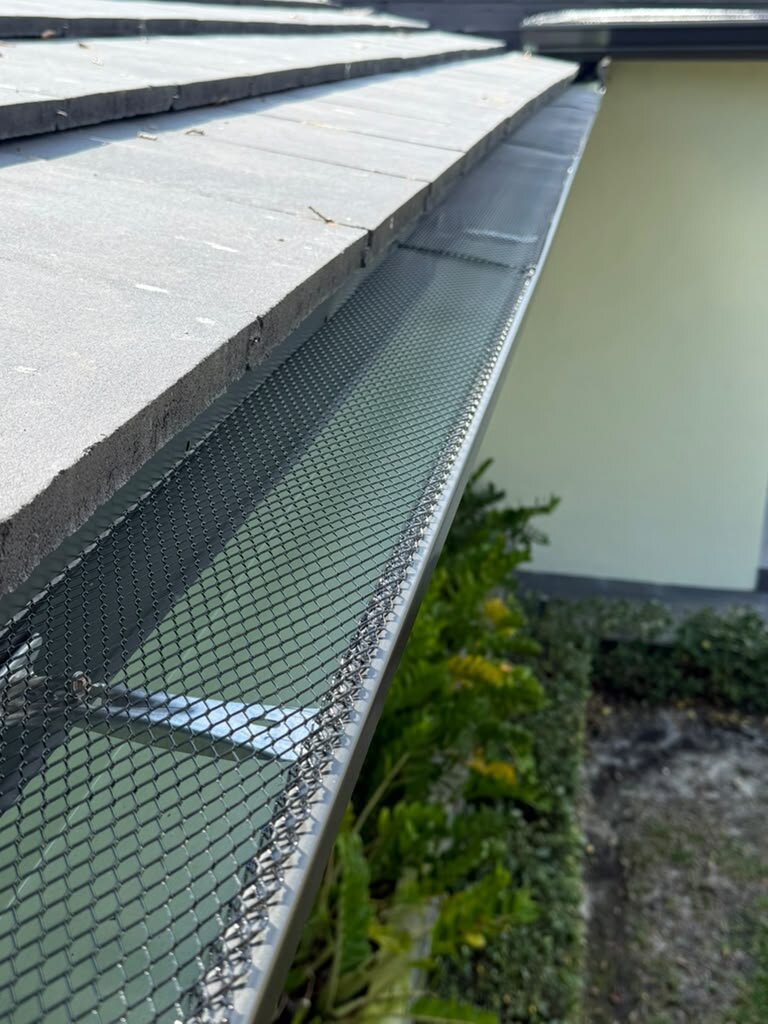
    Aluminium or stainless mesh. A perforated or woven screen over the trough. Good balance of cost and performance, and the type we fit most often. Stainless outlasts aluminium near salt air, which matters on the coast.

    Micro-mesh. A much finer screen, usually stainless on a frame. It stops the small material the standard mesh passes, and it is the best option under pines or anything that drops needles. It costs more and it needs the top brushed off occasionally, because fine mesh is exactly what pollen and dust mat onto.

    Reverse curve, or surface tension. A solid cover with a lip, relying on water clinging around the curve and into a slot while debris falls past. It works in moderate rain. In a two-inch-an-hour storm, a volume of water that is moving fast does not cling to anything — it carries straight over the lip and onto the ground. We do not recommend them here for that reason.

    Foam inserts. A block of foam filling the trough. Cheap, easy, and they degrade in UV, hold moisture against the metal, and eventually grow things. They are a short-term fix sold as a permanent one.

    Brush inserts. A large bottle brush laid in the gutter. Debris collects in the bristles rather than in the trough, which means you still have to pull the brush out to clean it. Marginally better than nothing.

    The South Florida specifics

    Royal palms shed fronds and seed pods that no guard will handle gracefully — a frond lands on top and sits there. If you have palms over the roof, plan on brushing the guards rather than clearing the gutters, and fit 3×4 downspouts so that anything which does get through keeps moving.

    Near the ocean, salt air eats cheap aluminium screen and the steel fasteners holding it. Stainless costs more at fitting and less over ten years.

    And whatever you fit, it has to be installed without lifting the roof edge. Guards that slide up under the first course of shingles or tiles can break the water seal at the eave, which trades a gutter problem for a roof problem. We fit to the gutter, not to the roof.

    Is it worth it

    Run the arithmetic on your own property. If you are paying for three clearings a year, guards typically pay for themselves in two to four years and remove the part of the job you dislike most — the ladder.

    If you have no trees near the roof and you clear the gutters once a year without much trouble, you probably do not need them, and we will tell you that.

    Joya General Services Gutter LLC fits gutter guards across Opa-locka, Miami and Fort Lauderdale. Call (786) 302-1221 and we will look at what is actually landing on your roof before recommending anything.

  • Protectores de canaletas: lo que hacen y lo que no

    Protectores de canaletas: lo que hacen y lo que no

    Los protectores de canaletas valen la pena en la mayoría de las propiedades del sur de la Florida que tienen árboles cerca del techo. No son la promesa de cero mantenimiento que sugiere parte de la publicidad, y la compañía que le diga que nunca más va a subir una escalera le está vendiendo algo.

    Esta es la versión honesta: lo que hacen, lo que no hacen y cuáles tipos valen el dinero aquí.

    Lo que hacen

    • Mantienen hojas, ramitas y semillas fuera del canal. Ese es el trabajo principal y un protector decente lo hace bien.
    • Alargan el intervalo entre limpiezas. Una propiedad que necesitaba limpieza tres veces al año normalmente pasa a una.
    • Evitan que el canal se vuelva un criadero. El mosquito se reproduce en el agua detenida por la basura. Menos basura, menos agua detenida.
    • Dejan fuera a pájaros y roedores. Una canaleta abierta llena de material seco es un sitio de anidación. Una con malla no.
    • Reducen el peso que cargan los soportes. La basura mojada y compactada pesa, y ese peso es lo que saca las corridas de línea.

    Lo que no hacen

    • No eliminan el mantenimiento. El material fino igual pasa la malla, y lo que cae encima del protector hay que barrerlo o se apelmaza y bota el agua por el borde.
    • No arreglan una canaleta del tamaño equivocado. Si la corrida se desborda porque quedó corta o le faltan salidas, el protector no cambia nada — y uno mal escogido lo empeora al estrechar la entrada.
    • No arreglan la caída. El agua parada de una corrida hundida sigue parada debajo del protector, y ahora usted no puede verla.
    • No detienen el polen, el granulado de las shingles ni el sedimento negro fino que se acumula como lodo en el fondo del canal.
    • No aguantan que los pisen. Cualquiera que recueste una escalera sobre una canaleta con protector sin saber lo que hace, la deforma.

    Los tipos, y cuáles sirven aquí

    Malla de aluminio o acero inoxidable. Una pantalla perforada o tejida sobre el canal. Buen equilibrio entre costo y rendimiento, y es el tipo que más instalamos. El inoxidable dura más que el aluminio cerca del aire salino, lo que importa en la costa.

    Micro-malla. Una pantalla mucho más fina, normalmente de inoxidable sobre un marco. Detiene el material pequeño que la malla común deja pasar, y es la mejor opción debajo de pinos o de cualquier cosa que suelte agujas. Cuesta más y hay que barrerle la parte de arriba de vez en cuando, porque una malla fina es exactamente donde se apelmazan el polen y el polvo.

    Curva invertida, o de tensión superficial. Una tapa sólida con un labio, que depende de que el agua se adhiera a la curva y entre por una ranura mientras la basura cae de largo. Funciona con lluvia moderada. En una tormenta de dos pulgadas por hora, un volumen de agua que va rápido no se adhiere a nada — pasa derecho por encima del labio y cae al suelo. Por eso no los recomendamos aquí.

    Insertos de espuma. Un bloque de espuma que llena el canal. Baratos, fáciles, y se degradan con el sol, retienen humedad contra el metal y con el tiempo les crece cosa adentro. Son un arreglo temporal vendido como permanente.

    Insertos de cepillo. Un cepillo grande acostado dentro de la canaleta. La basura se junta en las cerdas en vez de en el canal, lo que significa que igual hay que sacar el cepillo para limpiarlo. Apenas mejor que nada.

    Lo específico del sur de la Florida

    Las palmas reales sueltan pencas y racimos de semillas que ningún protector maneja con elegancia — una penca cae encima y ahí se queda. Si tiene palmas sobre el techo, cuente con barrer los protectores en vez de limpiar las canaletas, e instale bajantes de 3×4 para que lo que sí pase siga moviéndose.

    Cerca del mar, el aire salino se come la malla de aluminio barata y los tornillos de acero que la sujetan. El inoxidable cuesta más al instalar y menos a diez años.

    Y sea cual sea el que instale, tiene que ponerse sin levantar el borde del techo. Los protectores que se meten por debajo de la primera hilera de shingles o tejas pueden romper el sello de agua del alero, lo que cambia un problema de canaleta por un problema de techo. Nosotros fijamos a la canaleta, no al techo.

    ¿Vale la pena?

    Saque la cuenta en su propia propiedad. Si está pagando tres limpiezas al año, los protectores normalmente se pagan solos en dos a cuatro años y le quitan la parte del trabajo que menos le gusta: la escalera.

    Si no tiene árboles cerca del techo y limpia las canaletas una vez al año sin mucho problema, probablemente no los necesita, y se lo vamos a decir.

    Joya General Services Gutter LLC instala protectores de canaletas en Opa-locka, Miami y Fort Lauderdale. Llame al (786) 302-1221 y vamos a ver qué está cayendo de verdad sobre su techo antes de recomendarle nada.

  • Qué revisa de verdad una inspección de canaletas

    Qué revisa de verdad una inspección de canaletas

    Mirar bien un sistema de canaletas toma unos veinte minutos y cubre seis cosas. Se hace desde una escalera, no desde la entrada de autos. Si alguien le cotiza un cambio completo sin subir, está adivinando — y adivinar siempre termina en “hay que cambiarlo todo”.

    Esto es lo que revisamos, en el orden en que lo revisamos, para que usted sepa cómo se ve una inspección de verdad y pueda darse cuenta cuando no se la están haciendo.

    1. La caída

    Una corrida debe bajar alrededor de un cuarto de pulgada por cada diez pies para que el agua camine hacia la salida en vez de quedarse parada en el canal.

    Lo comprobamos con nivel y, mejor todavía, con agua. Agua parada después de llover significa que la caída está mal o que un soporte cedió y la corrida se hundió. El agua detenida en una canaleta cría mosquitos, agrega un peso para el que los soportes no fueron calculados y deja la línea oscura que se ve desde la calle.

    2. Los soportes y la fascia detrás de ellos

    Revisamos cómo está sujeta la corrida y a qué está sujeta. Los clavos se aflojan con el tiempo, sobre todo en fascia que ya estuvo mojada. Los soportes ocultos deben ir espaciados unos dos pies, más cerrado en corridas largas o expuestas.

    Después revisamos la tabla misma. Un tornillo vale lo que vale la madera que lo sostiene, y la fascia blanda es la causa número uno de que una reparación se convierta en un trabajo mayor. Presionamos a lo largo de la tabla detrás de la canaleta — si cede, usted necesita carpintería antes que canaletas, y se lo vamos a decir.

    3. Las costuras y el sellador

    En un sistema por secciones se revisa cada unión. El sellador dura bastante menos que el metal que está sellando, y en este clima se agrieta, se encoge y se levanta por los bordes.

    En un sistema sin costuras solo hay esquinas y salidas que revisar, que es justamente para lo que se instala. Las esquinas siguen siendo el punto a mirar: reciben el mayor movimiento y ahí es donde aparece casi toda filtración que encontramos en canaleta sin costuras.

    4. Las salidas y los bajantes

    Contamos las salidas contra el largo de la corrida y el área de techo que la alimenta, y revisamos el tamaño de lo instalado — 2×3 o 3×4.

    Después comprobamos que estén libres. La obstrucción común no está en la canaleta: está en el codo arriba del bajante, donde el tubo gira y la basura deja de moverse. Lo lavamos y escuchamos. Un bajante que gorgotea o golpetea cuando llueve fuerte le está diciendo que tiene una restricción.

    5. A dónde va el agua después del bajante

    Este es el paso que más se salta y el que causa el daño caro. Miramos dónde descarga cada bajante, a qué distancia queda eso de la pared y hacia dónde cae el terreno una vez que el agua aterriza.

    Un sistema puede estar en perfecto estado desde el techo hasta el pie del bajante y aun así estar empapando la cimentación.

    6. El borde del techo y la línea de goteo

    Por último miramos la relación entre el techo y la canaleta: si el borde de goteo entrega el agua dentro del canal o por detrás, si un plano inclinado está lanzando el agua por encima del borde delantero, y si las tejas o shingles del alero se movieron.

    También miramos el terreno bajo la línea de goteo. Una zanja cavada en la tierra o el mulch le dice dónde ha estado desbordándose el sistema, aunque usted nunca lo haya visto pasar.

    Qué debe recibir al final

    Le deben decir tres cosas, claras: qué está mal, qué cuesta arreglarlo y qué está bien y no hay que tocar. Esa última es la prueba. Una inspección que encuentra todos los componentes defectuosos es una visita de ventas.

    También le deben decir qué es urgente y qué puede esperar a la próxima temporada. No todo hay que hacerlo ahora, y preferimos programar la reparación del borde del techo antes de la temporada de lluvia y dejar la mancha cosmética para después.

    Cada cuánto

    Una vez al año para la mayoría de las propiedades de aquí, y dos veces donde hay árboles cerca del techo — una antes de la temporada de lluvia y otra después de que caiga la hoja. Si pasó una tormenta, revise antes.

    Joya General Services Gutter LLC inspecciona sistemas de canaletas en Opa-locka, Miami y Fort Lauderdale. La revisión es gratis. Llame al (786) 302-1221.

  • Cómo elegir las canaletas adecuadas para su casa

    Cómo elegir las canaletas adecuadas para su casa

    La mayoría de las casas en el sur de la Florida llevan canaleta tipo K de 5 pulgadas, y en un techo de una planta esa es la medida correcta. La decisión que de verdad importa casi nunca es la forma. Es la capacidad, el grosor del aluminio y cómo queda sujeta la corrida a la fascia — y esas tres cosas son las que separan una canaleta que aguanta la temporada de huracanes de una que se despega de la casa en agosto.

    Así es como medimos un trabajo cuando vamos a verlo.

    Se mide por el techo, no por la casa

    Una canaleta se dimensiona por la cantidad de agua que le llega, y eso depende de tres cosas: el área de techo que drena hacia esa corrida, qué tan inclinado está el techo y con qué fuerza llueve donde usted vive.

    Las dos primeras se miden en el sitio. La tercera es la que la gente subestima. Una tormenta de la tarde en el sur de la Florida puede dejar dos pulgadas de lluvia en una hora. Una canaleta calculada para lluvia promedio aguanta eso unos diez minutos y después se desborda por el frente en una cortina de agua — que es justo el momento en que nos llaman, casi siempre mirando por la ventana.

    Un techo inclinado lo empeora. El agua llega al borde más rápido y con más impulso, así que una parte salta por encima de la canaleta en vez de caer dentro. En pendientes fuertes subimos de medida o corremos la canaleta un poco más afuera y abajo para atrapar el chorro.

    Cinco pulgadas o seis pulgadas

    La canaleta tipo K de 6 pulgadas carga alrededor de 40 por ciento más agua que la de 5, por una diferencia de precio pequeña al lado de lo que cuesta cambiar un sofito. La recomendamos cuando:

    • El área de techo que drena hacia una sola corrida es grande — planos largos, o varios planos cayendo en un mismo valle.
    • El techo tiene mucha pendiente, o es de metal, que suelta el agua más rápido que la teja o la shingle.
    • No hay dónde poner otro bajante, así que el que existe tiene que hacer más trabajo.
    • La corrida ya se desborda y la canaleta por lo demás está sana.

    La de 6 pulgadas además se acompaña de bajante de 3×4 en lugar del 2×3 común, y muchas veces ese es el arreglo verdadero. La canaleta nunca fue el cuello de botella; el bajante sí.

    Aquí vale la pena la canaleta sin costuras

    La canaleta en secciones viene en tramos y se une cada pocos pies. Cada unión es una costura, cada costura lleva sellador, y todo sellador dura menos que el metal que está sellando. En un clima que alterna lluvia fuerte y sol duro, esas uniones son lo primero que falla.

    La canaleta sin costuras se forma en el sitio. La máquina convierte un rollo de aluminio en un tramo continuo cortado a la medida exacta de su corrida, así que las únicas uniones de todo el sistema quedan en las esquinas y en las salidas. Menos uniones, menos filtraciones, y ninguna línea visible cada diez pies cruzando el frente de la casa.

    Ese es el estándar que instalamos. No es una mejora que le vendemos — es lo que traemos en el camión.

    El grosor es el dato que nadie le cotiza

    El aluminio para canaleta se ofrece normalmente en .027 y .032 de pulgada. El más fino es más barato y se abolla — una escalera recostada, una rama, un granizo. El más grueso mantiene su forma, agarra mejor el tornillo del soporte y resiste que le pasen por al lado todas las semanas.

    Si está comparando dos cotizaciones y una es notablemente más barata, el calibre es lo primero que debe mirar. Lo segundo son los soportes.

    Ponga atención a los soportes

    Los clavos pasados a través de la canaleta hasta la fascia se van aflojando. Se aflojan más rápido en madera que ya estuvo mojada, que describe a buena parte de las fascias de Miami-Dade y Broward. Cuando uno cede, la corrida se hunde, el agua se empoza en el punto bajo en vez de correr hacia la salida, y el hundimiento empeora con el peso.

    Los soportes ocultos atornillados a la fascia cada dos pies mantienen la línea recta durante toda la temporada, reparten la carga entre más puntos y no se ven desde abajo. En fachadas expuestas y en corridas largas cerramos todavía más ese espaciado.

    La caída no es opcional

    Una corrida tiene que bajar alrededor de un cuarto de pulgada por cada diez pies de largo para que el agua camine hacia la salida en vez de quedarse parada en el canal. El agua parada es lo que cría mosquitos, produce las manchas oscuras que se ven desde la calle y agrega un peso para el que los soportes no fueron calculados.

    No debería notarse desde el suelo. Si usted ve su canaleta inclinada, está demasiado inclinada — y si queda agua adentro después de que para de llover, no tiene suficiente caída.

    Qué hacemos cuando vamos a verlo

    Medimos cada corrida, contamos los planos de techo que le caen encima, revisamos la fascia detrás de la canaleta existente y le decimos si lo que tiene hay que cambiarlo o solamente sellarlo y volverlo a colgar. A veces la respuesta es que su canaleta está bien y el problema es un bajante que está botando el agua a dos pies de la pared.

    Ir a ver no cuesta nada, y cuando la reparación barata es la correcta, se lo decimos.

    Joya General Services Gutter LLC instala canaletas de aluminio sin costuras en Opa-locka, Miami y Fort Lauderdale. Llame al (786) 302-1221 para una cotización medida y gratis.