
Tag: Home

  • How to Choose the Right Guttering for Your Home

    How to Choose the Right Guttering for Your Home

    Most homes in South Florida are fitted with 5-inch K-style gutter, and on a typical single-storey roof that is the right call. The decision that actually matters is rarely the shape. It is the capacity, the thickness of the metal, and how the run is hung on the fascia — and those three are what separate a gutter that survives a hurricane season from one that comes off the house in August.

    Here is how we size a job when we come out to look at it.

    Start with the roof, not the house

    A gutter is sized by how much water reaches it, and that depends on three things: the area of roof draining into that run, how steep the roof is, and how hard it rains where you live.

    The first two are measurable on site. The third is the one homeowners underestimate. A South Florida afternoon storm can drop two inches of rain in an hour. Guttering specified for average rainfall will carry that for about ten minutes and then overshoot the front edge in a sheet — which is the moment people call us, usually while standing at a window watching it happen.

    A steep roof makes it worse. Water arrives at the eave faster and with more momentum, so some of it skips the gutter entirely rather than dropping into it. On a steep slope we either go up a size or move the run slightly out and down to catch the throw.

    Five-inch or six-inch

    Six-inch K-style carries roughly 40 percent more water than 5-inch, for a difference in price that is small next to the cost of replacing soffit. We recommend it when:

    • The catchment area draining into one run is large — long roof planes, or several planes feeding one valley.
    • The roof is steep, or it is metal, which sheds faster than shingle or tile.
    • There is nowhere sensible to add another downspout, so the existing one has to do more work.
    • The run already overflows and the gutter itself is otherwise sound.

    Six-inch gutter also pairs with a 3×4 downspout instead of the standard 2×3, and that is often the real fix. The gutter was never the bottleneck; the outlet was.

    Seamless is worth it here

    Sectional gutter comes in lengths and is joined every few feet. Every joint is a seam, every seam is sealed, and every sealant joint has a service life shorter than the metal around it. In a climate that cycles between heavy rain and hard sun, those joints are the first thing to fail.

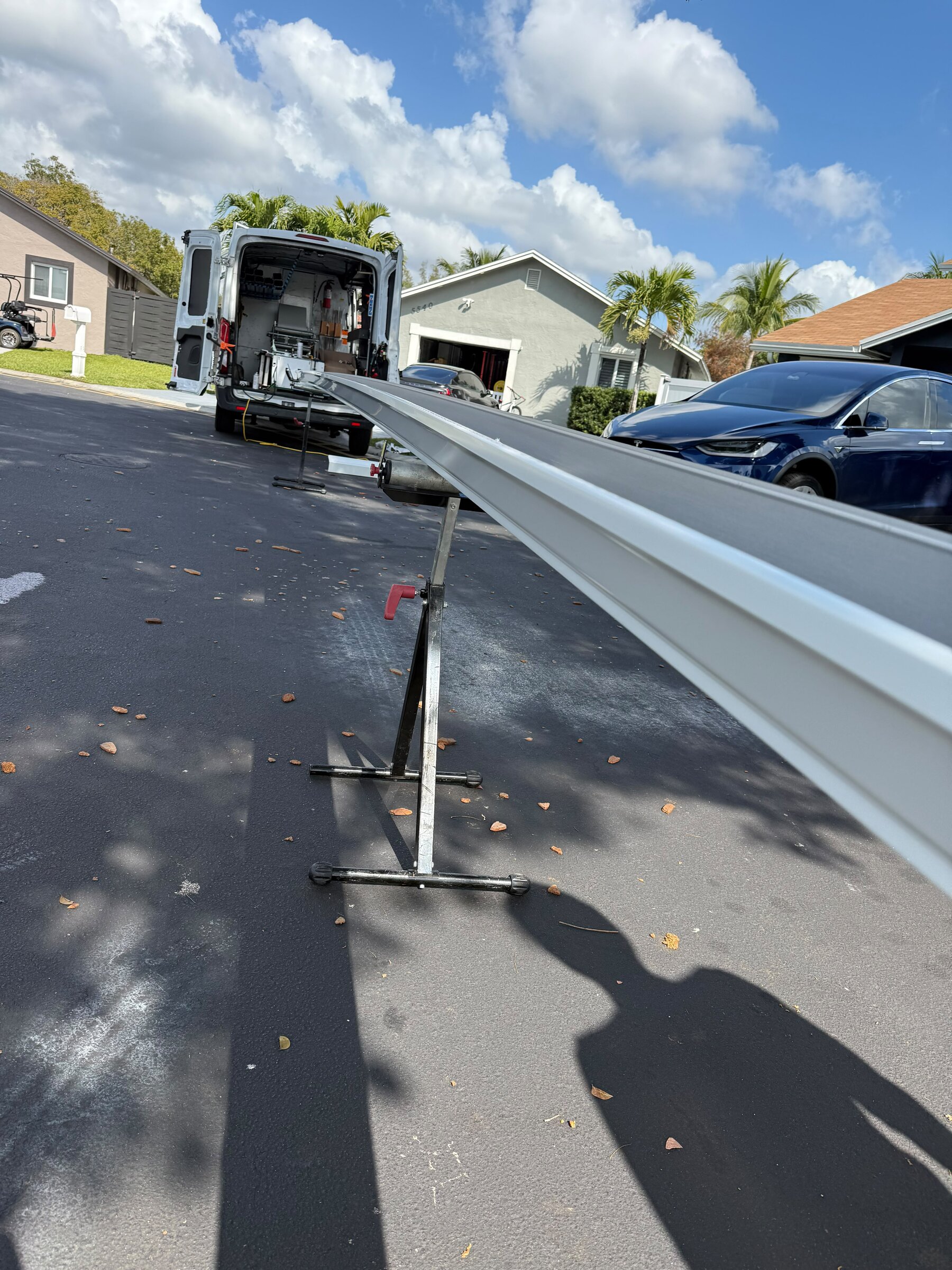
    Seamless gutter is formed on site. The machine rolls a coil of aluminium into a continuous length cut to the exact measurement of your run, so the only joints in the whole system are at the corners and the outlets. Fewer joints, fewer leaks, and no visible line every ten feet across the front of the house.

    That is the standard we install. It is not an upgrade we sell — it is what we bring on the truck.

    Thickness is the spec nobody quotes

    Aluminium gutter is commonly offered in .027 inch and .032 inch. The thinner one is cheaper and it dents — a ladder set against it, a branch, a hailstone. The thicker one holds its shape, holds a hanger screw better, and stands up to being walked past by a lawn crew every week.

    If you are comparing two quotes and one is noticeably cheaper, the gauge is the first place to look. The second is the hangers.

    Watch the hangers

    Spikes driven through the gutter into the fascia work loose. They loosen faster in wood that has already been wet, which describes a lot of fascia board in Miami-Dade and Broward. Once one lets go the run sags, water pools at the low point instead of running to the outlet, and the sag gets worse under the weight.

    Hidden hangers screwed into the fascia every two feet hold the line straight through a storm season, carry the load across more points, and are invisible from the ground. On exposed elevations and anywhere the run is long, we tighten that spacing.

    The fall is not optional

    A run has to drop about a quarter of an inch for every ten feet of length so that water moves towards the outlet instead of standing in the trough. Standing water is what breeds mosquitoes, grows the dark streaks you can see from the street, and adds weight the hangers were not sized for.

    It should not be visible from the ground. If you can see your gutter sloping, it is sloping too much — and if water sits in it after the rain stops, it is not sloping enough.

    What we do when we come out

    We measure each run, count the roof planes feeding it, look at the fascia behind the existing gutter, and tell you whether what you have needs replacing or only resealing and rehanging. Sometimes the answer is that your gutter is fine and the problem is a downspout discharging two feet from the wall.

    There is no charge for looking, and we will tell you when the cheaper repair is the right one.

    Joya General Services Gutter LLC installs seamless aluminium guttering across Opa-locka, Miami and Fort Lauderdale. Call (786) 302-1221 for a free measured quote.

  • Cómo elegir las canaletas adecuadas para su casa

    Cómo elegir las canaletas adecuadas para su casa

    La mayoría de las casas en el sur de la Florida llevan canaleta tipo K de 5 pulgadas, y en un techo de una planta esa es la medida correcta. La decisión que de verdad importa casi nunca es la forma. Es la capacidad, el grosor del aluminio y cómo queda sujeta la corrida a la fascia — y esas tres cosas son las que separan una canaleta que aguanta la temporada de huracanes de una que se despega de la casa en agosto.

    Así es como medimos un trabajo cuando vamos a verlo.

    Se mide por el techo, no por la casa

    Una canaleta se dimensiona por la cantidad de agua que le llega, y eso depende de tres cosas: el área de techo que drena hacia esa corrida, qué tan inclinado está el techo y con qué fuerza llueve donde usted vive.

    Las dos primeras se miden en el sitio. La tercera es la que la gente subestima. Una tormenta de la tarde en el sur de la Florida puede dejar dos pulgadas de lluvia en una hora. Una canaleta calculada para lluvia promedio aguanta eso unos diez minutos y después se desborda por el frente en una cortina de agua — que es justo el momento en que nos llaman, casi siempre mirando por la ventana.

    Un techo inclinado lo empeora. El agua llega al borde más rápido y con más impulso, así que una parte salta por encima de la canaleta en vez de caer dentro. En pendientes fuertes subimos de medida o corremos la canaleta un poco más afuera y abajo para atrapar el chorro.

    Cinco pulgadas o seis pulgadas

    La canaleta tipo K de 6 pulgadas carga alrededor de 40 por ciento más agua que la de 5, por una diferencia de precio pequeña al lado de lo que cuesta cambiar un sofito. La recomendamos cuando:

    • El área de techo que drena hacia una sola corrida es grande — planos largos, o varios planos cayendo en un mismo valle.
    • El techo tiene mucha pendiente, o es de metal, que suelta el agua más rápido que la teja o la shingle.
    • No hay dónde poner otro bajante, así que el que existe tiene que hacer más trabajo.
    • La corrida ya se desborda y la canaleta por lo demás está sana.

    La de 6 pulgadas además se acompaña de bajante de 3×4 en lugar del 2×3 común, y muchas veces ese es el arreglo verdadero. La canaleta nunca fue el cuello de botella; el bajante sí.

    Aquí vale la pena la canaleta sin costuras

    La canaleta en secciones viene en tramos y se une cada pocos pies. Cada unión es una costura, cada costura lleva sellador, y todo sellador dura menos que el metal que está sellando. En un clima que alterna lluvia fuerte y sol duro, esas uniones son lo primero que falla.

    La canaleta sin costuras se forma en el sitio. La máquina convierte un rollo de aluminio en un tramo continuo cortado a la medida exacta de su corrida, así que las únicas uniones de todo el sistema quedan en las esquinas y en las salidas. Menos uniones, menos filtraciones, y ninguna línea visible cada diez pies cruzando el frente de la casa.

    Ese es el estándar que instalamos. No es una mejora que le vendemos — es lo que traemos en el camión.

    El grosor es el dato que nadie le cotiza

    El aluminio para canaleta se ofrece normalmente en .027 y .032 de pulgada. El más fino es más barato y se abolla — una escalera recostada, una rama, un granizo. El más grueso mantiene su forma, agarra mejor el tornillo del soporte y resiste que le pasen por al lado todas las semanas.

    Si está comparando dos cotizaciones y una es notablemente más barata, el calibre es lo primero que debe mirar. Lo segundo son los soportes.

    Ponga atención a los soportes

    Los clavos pasados a través de la canaleta hasta la fascia se van aflojando. Se aflojan más rápido en madera que ya estuvo mojada, que describe a buena parte de las fascias de Miami-Dade y Broward. Cuando uno cede, la corrida se hunde, el agua se empoza en el punto bajo en vez de correr hacia la salida, y el hundimiento empeora con el peso.

    Los soportes ocultos atornillados a la fascia cada dos pies mantienen la línea recta durante toda la temporada, reparten la carga entre más puntos y no se ven desde abajo. En fachadas expuestas y en corridas largas cerramos todavía más ese espaciado.

    La caída no es opcional

    Una corrida tiene que bajar alrededor de un cuarto de pulgada por cada diez pies de largo para que el agua camine hacia la salida en vez de quedarse parada en el canal. El agua parada es lo que cría mosquitos, produce las manchas oscuras que se ven desde la calle y agrega un peso para el que los soportes no fueron calculados.

    No debería notarse desde el suelo. Si usted ve su canaleta inclinada, está demasiado inclinada — y si queda agua adentro después de que para de llover, no tiene suficiente caída.

    Qué hacemos cuando vamos a verlo

    Medimos cada corrida, contamos los planos de techo que le caen encima, revisamos la fascia detrás de la canaleta existente y le decimos si lo que tiene hay que cambiarlo o solamente sellarlo y volverlo a colgar. A veces la respuesta es que su canaleta está bien y el problema es un bajante que está botando el agua a dos pies de la pared.

    Ir a ver no cuesta nada, y cuando la reparación barata es la correcta, se lo decimos.

    Joya General Services Gutter LLC instala canaletas de aluminio sin costuras en Opa-locka, Miami y Fort Lauderdale. Llame al (786) 302-1221 para una cotización medida y gratis.