
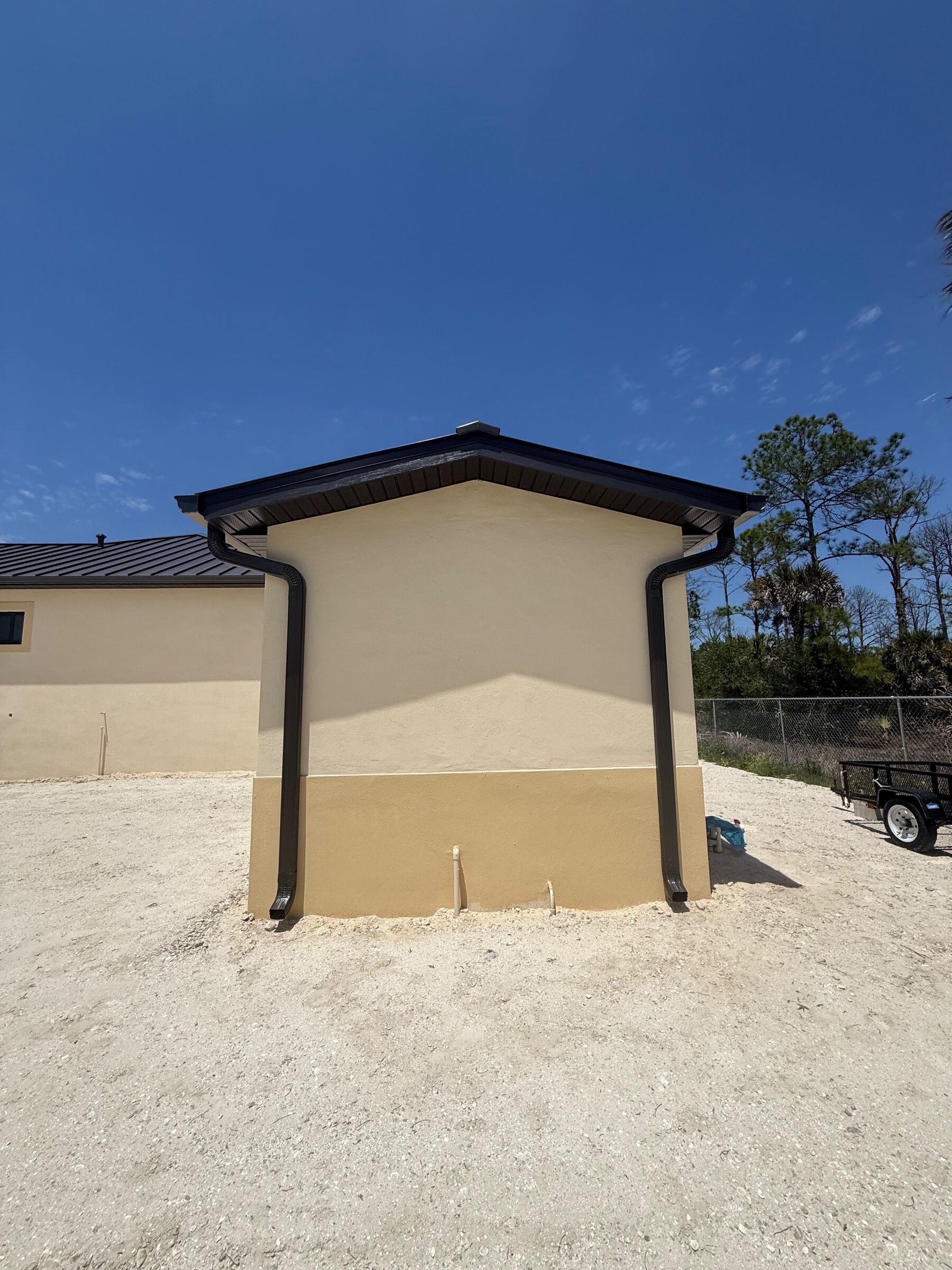
Tag: Drainage

  • Why Downspouts Matter More Than You Think

    Why Downspouts Matter More Than You Think

    A gutter only moves water sideways. The downspout is the part that takes it down and away from the building, and on most of the houses we are called out to, the gutter is fine and the downspouts are the problem.

    They are also the cheapest part of the system to get right. Adding an outlet costs a fraction of replacing a run, and it solves more complaints than any other single change we make.

    How many outlets a run actually needs

    The working rule is one downspout for roughly every 30 to 40 feet of gutter, and fewer than that where the roof feeding the run is large or steep. Long runs with a single outlet at one end are common on older houses here, usually because the original builder was counting corners rather than water.

    What happens is predictable. Water entering at the far end has to travel the entire length before it can leave, the trough fills faster than the one outlet can drain it, and the excess goes over the front lip somewhere in the middle. People see water pouring off the centre of a run and assume the gutter is blocked. Often it is simply outnumbered.

    Two by three, or three by four

    The standard residential downspout is 2×3 inches. The larger size is 3×4, and it moves substantially more water — close to double, in practice, because the bigger cross-section is also far less prone to jamming.

    That second point matters more than the arithmetic. A 2×3 outlet is narrow enough that a single palm frond, a tennis ball, or a season of seed pods can choke it. A 3×4 passes the same debris without stopping. On any property with trees close to the roof, we fit the larger size as a matter of course.

    Where the water lands is half the job

    A downspout that discharges at the base of the wall has moved the problem four feet, not solved it. The water now soaks into the ground directly against the foundation, which is the exact place you were trying to keep it away from.

    What the discharge point should do:

    • Carry water clear of the structure. Four to six feet is a reasonable minimum, further on a slab that sits low.
    • Release onto something that drains. Turf, gravel, a splash block — not bare soil that will wash out into a trench within a season.
    • Run away from the house, not along it. Grade matters. We check it with a level, because eyes are unreliable on a flat lot.
    • Keep clear of walkways. Water across a path is an algae problem and, eventually, somebody’s fall.

    Where there is no room for a surface extension — a narrow side yard, a paved path tight to the wall — the answer is usually a buried line running out to a pop-up emitter in the lawn. It costs more than an elbow and a splash block, and it is the right fix on a tight lot.

    Signs yours are undersized or wrongly placed

    • Water overshooting the middle of a run while the ends stay dry.
    • A gurgle or a knock from the downspout in heavy rain — air trapped behind a restriction.
    • A fan of soil or mulch washed away under the outlet.
    • A permanent damp patch on the stucco below the discharge point.
    • Water standing against the slab for hours after the rain has stopped.
    • Dark staining down the outside of the downspout itself, which means it is overflowing at a joint.

    The part that costs money later

    Water repeatedly soaking the ground against a slab does not announce itself. It shows up as a hairline crack that was not there last year, as a door that stops closing cleanly, as efflorescence — that white powder — on the inside face of a wall.

    Those are expensive to chase and cheap to prevent. A correctly sized outlet and a six-foot extension are a morning’s work.

    What we check

    When we look at a property we count the outlets against the length and the catchment area of each run, check the size of what is fitted, look at where every downspout actually discharges, and test the grade away from the wall. Then we tell you which ones need moving, which need upsizing, and which are fine as they are.

    Often the recommendation is to add one outlet. We would rather say that than sell you a new system you do not need.

    Joya General Services Gutter LLC fits and repairs downspouts and drainage across Opa-locka, Miami and Fort Lauderdale. Call (786) 302-1221 and we will come and look at no charge.
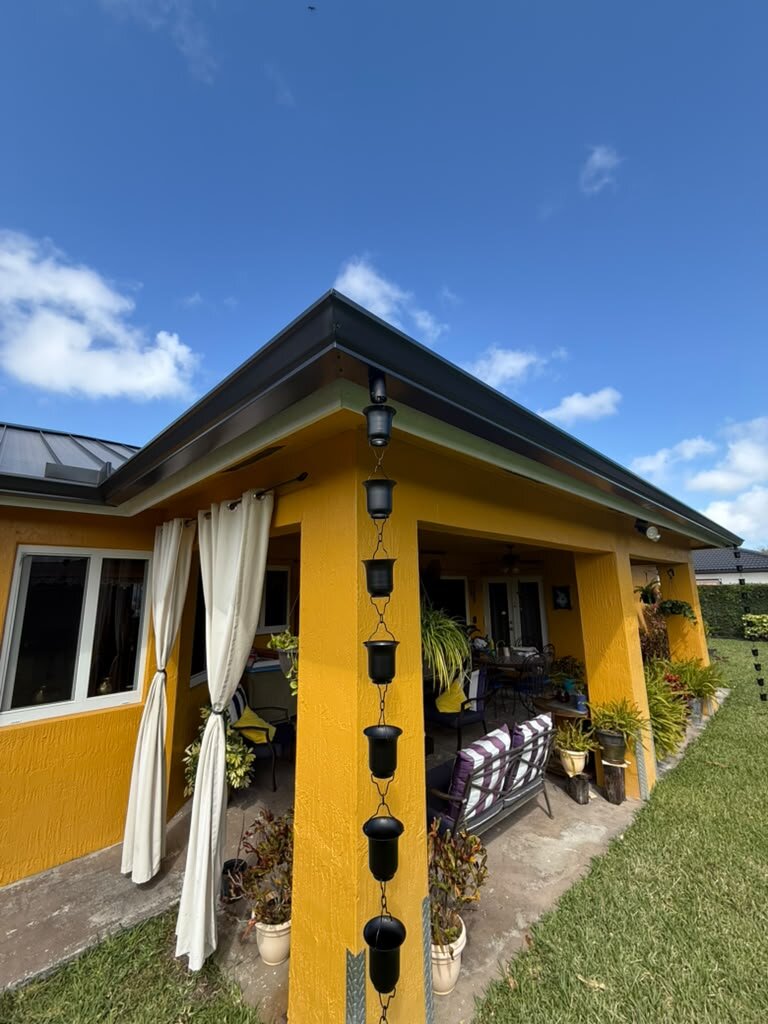
  • Why Proper Roof Drainage Is Essential

    Why Proper Roof Drainage Is Essential

    Rainfall in South Florida does not arrive gently. An afternoon storm can drop two inches in an hour, and the wet season runs from May into October — overlapping almost exactly with hurricane season, which officially starts on 1 June and ends on 30 November.

    A drainage system that copes with ordinary rain will not necessarily cope with that. The difference between the two shows up on the building, and it shows up in a specific order.

    The fascia goes first

    When a gutter overflows, the water does not fall cleanly away from the house. Surface tension pulls a good part of it backwards, behind the gutter and down the face of the fascia board.

    That board is usually wood. It is painted, not sealed, and it is now getting wet from behind where nobody can see it and where it never dries properly. Rot starts at the hanger screws, spreads along the grain, and the first visible symptom is often the gutter itself starting to pull away — because there is nothing solid left to hold the screws.

    By then you are not buying a gutter. You are buying carpentry, then a gutter.

    Then the soffit

    Water tracking behind the fascia gets into the soffit, the underside of the overhang. Vented soffit panels are designed to let air into the roof space, which means they will also let water in.

    Signs it is already happening: staining on the soffit panels, panels sagging out of their channel, or a smell of damp under the overhang after rain. In a roof space, the same water shows up as dark patches on the underside of the deck.

    Then the wall and what is behind it

    Water running down an exterior wall finds every opening — a hairline crack in the stucco, the gap around a hose bib, the seal at a window head. Inside the wall cavity it has nowhere to go and nothing moving the air, which in this climate is all mould needs.

    Efflorescence, the chalky white bloom that appears on block and stucco, is the visible marker that water has been moving through the wall and leaving its minerals behind. It is cosmetic in itself. It is a warning about what is not cosmetic.

    Then the ground, which is the expensive one

    Water discharging against the house soaks the ground next to the slab over and over. The soil swells wet and shrinks dry, and the slab edge moves with it.

    That movement is what produces hairline cracks in a floor, a door that binds in its frame during the wet season and releases in the dry, and tiles that lift along a line. These are the repairs nobody budgets for, and the cause is usually something that cost a few hundred dollars to fix before it started.

    Outside, the same water scours a trench under the drip line, undermines the edge of a driveway or a paver path, and carries mulch and soil out across the walkway with every storm.

    What correct drainage actually looks like

    • Capacity matched to the roof. The run is sized for the area draining into it, not for what fits the look of the house.
    • Enough outlets. One downspout for roughly every 30 to 40 feet of run, more where the catchment is large.
    • Fall towards the outlets. About a quarter inch per ten feet, so nothing stands in the trough.
    • Secure hanging. Hidden hangers into sound fascia every two feet, so a storm does not take the run with it.
    • Discharge well clear of the building. Four to six feet minimum, onto ground that drains, sloping away.
    • Nothing blocked. Capacity you cannot use is not capacity.

    Before the season, not during it

    The useful window for this work is spring, before the wet season builds. Once the storms are arriving weekly, every gutter company in Miami-Dade and Broward is booked, and the work gets done between downpours.

    If you only do one thing, walk the perimeter during the next heavy rain and watch where the water goes. Overflow, a stream running down a wall, or a puddle sitting against the slab tells you more in five minutes than an inspection on a dry day.

    Joya General Services Gutter LLC designs and fits rainwater drainage across Opa-locka, Miami and Fort Lauderdale. Call (786) 302-1221 and we will come and tell you what your roof is actually doing with its water.

  • Por qué un buen drenaje de techo es indispensable

    Por qué un buen drenaje de techo es indispensable

    La lluvia en el sur de la Florida no llega despacio. Una tormenta de la tarde puede dejar dos pulgadas en una hora, y la temporada de lluvia va de mayo hasta octubre — solapándose casi exactamente con la temporada de huracanes, que oficialmente empieza el 1 de junio y termina el 30 de noviembre.

    Un sistema de drenaje que aguanta lluvia normal no necesariamente aguanta eso. La diferencia entre las dos se nota en el edificio, y se nota en un orden concreto.

    Primero se va la fascia

    Cuando una canaleta se desborda, el agua no cae limpia hacia afuera. La tensión superficial se lleva buena parte hacia atrás, por detrás de la canaleta y por la cara de la tabla de fascia.

    Esa tabla casi siempre es de madera. Está pintada, no sellada, y ahora se está mojando por detrás, donde nadie la ve y donde nunca seca bien. La pudrición empieza en los tornillos de los soportes, sigue la veta, y el primer síntoma visible suele ser la canaleta despegándose — porque ya no queda nada firme que sujete los tornillos.

    A esa altura usted no está comprando una canaleta. Está comprando carpintería, y después una canaleta.

    Después el sofito

    El agua que corre detrás de la fascia se mete en el sofito, la parte de abajo del alero. Los paneles ventilados están diseñados para dejar entrar aire al techo, lo que significa que también van a dejar entrar agua.

    Señales de que ya está pasando: manchas en los paneles del sofito, paneles descolgándose de su canal, u olor a humedad debajo del alero después de llover. Dentro del entretecho, la misma agua aparece como manchas oscuras en la cara inferior de la cubierta.

    Después la pared y lo que hay dentro de ella

    El agua que baja por una pared exterior encuentra cada abertura — una grieta fina en el repello, el hueco alrededor de la llave de manguera, el sello en el cabezal de una ventana. Dentro de la pared no tiene a dónde ir y no hay aire moviéndose, que en este clima es todo lo que el moho necesita.

    La eflorescencia, ese polvo blanco que aparece sobre el bloque y el repello, es la marca visible de que el agua ha estado pasando por la pared y dejando sus minerales. En sí misma es cosmética. Es un aviso sobre algo que no lo es.

    Después el terreno, que es el caro

    El agua que descarga contra la casa empapa una y otra vez el terreno junto a la losa. El suelo se hincha mojado y se encoge seco, y el borde de la losa se mueve con él.

    Ese movimiento es lo que produce grietas finas en un piso, una puerta que se traba en temporada de lluvia y se suelta en la seca, y lozas que se levantan siguiendo una línea. Son las reparaciones que nadie presupuesta, y la causa casi siempre fue algo que costaba unos cientos de dólares arreglar antes de que empezara.

    Por fuera, esa misma agua cava una zanja bajo la línea de goteo, socava el borde de una entrada de autos o de un camino de adoquines, y se lleva el mulch y la tierra por encima de la acera con cada tormenta.

    Cómo se ve un drenaje correcto

    • Capacidad acorde al techo. La corrida se dimensiona por el área que le drena, no por lo que combina con la casa.
    • Suficientes salidas. Un bajante por cada 30 a 40 pies de corrida, más donde el área de captación es grande.
    • Caída hacia las salidas. Alrededor de un cuarto de pulgada por cada diez pies, para que no quede nada parado en el canal.
    • Sujeción firme. Soportes ocultos sobre fascia sana cada dos pies, para que una tormenta no se lleve la corrida.
    • Descarga bien lejos del edificio. De cuatro a seis pies mínimo, sobre terreno que drene y en pendiente hacia afuera.
    • Nada tupido. La capacidad que no se puede usar no es capacidad.

    Antes de la temporada, no durante

    La ventana útil para este trabajo es la primavera, antes de que la temporada de lluvia agarre fuerza. Cuando ya las tormentas llegan todas las semanas, todas las compañías de canaletas de Miami-Dade y Broward están llenas, y el trabajo se hace entre aguaceros.

    Si va a hacer una sola cosa, camine el perímetro durante la próxima lluvia fuerte y mire a dónde va el agua. Un desborde, un chorro bajando por la pared o un charco contra la losa le dicen más en cinco minutos que una inspección en día seco.

    Joya General Services Gutter LLC diseña e instala drenaje pluvial en Opa-locka, Miami y Fort Lauderdale. Llame al (786) 302-1221 y vamos a decirle qué está haciendo su techo con el agua.

  • Por qué los bajantes importan más de lo que usted cree

    Por qué los bajantes importan más de lo que usted cree

    La canaleta solamente mueve el agua de lado. El bajante es la pieza que la baja y la aleja del edificio, y en la mayoría de las casas a las que nos llaman, la canaleta está bien y el problema son los bajantes.

    También son la parte más barata de corregir. Agregar una salida cuesta una fracción de lo que cuesta cambiar una corrida, y resuelve más quejas que cualquier otro cambio que hagamos.

    Cuántas salidas necesita de verdad una corrida

    La regla de trabajo es un bajante por cada 30 a 40 pies de canaleta, y menos distancia todavía cuando el techo que alimenta la corrida es grande o inclinado. Las corridas largas con una sola salida en una punta son comunes en las casas viejas de aquí, normalmente porque el constructor original estaba contando esquinas y no agua.

    Lo que pasa es previsible. El agua que entra por el extremo lejano tiene que recorrer todo el largo antes de poder salir, el canal se llena más rápido de lo que esa única salida puede drenar, y el sobrante se va por el borde delantero en algún punto del medio. La gente ve el agua cayendo por el centro de la corrida y supone que la canaleta está tupida. Muchas veces simplemente está superada en número.

    Dos por tres, o tres por cuatro

    El bajante residencial estándar es de 2×3 pulgadas. El tamaño mayor es 3×4, y mueve bastante más agua — casi el doble en la práctica, porque la sección más grande además se tupe mucho menos.

    Ese segundo punto importa más que la cuenta. Un bajante de 2×3 es lo bastante estrecho como para que una sola penca de palma, una pelota de tenis o una temporada de semillas lo tapen. Uno de 3×4 deja pasar lo mismo sin detenerse. En cualquier propiedad con árboles cerca del techo, instalamos el tamaño grande por norma.

    Dónde cae el agua es la mitad del trabajo

    Un bajante que descarga al pie de la pared movió el problema cuatro pies, no lo resolvió. Ahora el agua se filtra en el terreno pegado a la cimentación, que es exactamente el lugar del que usted estaba tratando de alejarla.

    Lo que debe hacer el punto de descarga:

    • Llevar el agua lejos de la estructura. De cuatro a seis pies es un mínimo razonable, y más en una losa que queda baja.
    • Soltarla sobre algo que drene. Grama, gravilla, un bloque difusor — no tierra pelada que en una temporada se convierte en una zanja.
    • Correr alejándose de la casa, no a lo largo de ella. El nivel del terreno manda. Lo medimos con nivel, porque el ojo engaña en un lote plano.
    • Mantenerse fuera de los caminos. Agua cruzando una acera es un problema de algas y, con el tiempo, la caída de alguien.

    Donde no hay espacio para una extensión en superficie — un costado estrecho, un camino pegado a la pared — la solución suele ser una línea enterrada que sale a un emisor en el césped. Cuesta más que un codo y un bloque difusor, y en un lote apretado es lo correcto.

    Señales de que los suyos quedaron cortos o mal ubicados

    • Agua desbordándose por el medio de una corrida mientras las puntas siguen secas.
    • Un gorgoteo o un golpeteo en el bajante cuando llueve fuerte — aire atrapado detrás de una restricción.
    • Un abanico de tierra o mulch lavado debajo de la salida.
    • Una mancha de humedad permanente en el repello debajo del punto de descarga.
    • Agua parada contra la losa horas después de que paró de llover.
    • Manchas oscuras por fuera del propio bajante, que significan que se está desbordando por una unión.

    La parte que cuesta dinero después

    El agua empapando una y otra vez el terreno contra la losa no avisa. Aparece como una grieta fina que el año pasado no estaba, como una puerta que deja de cerrar bien, como eflorescencia — ese polvo blanco — en la cara interior de una pared.

    Eso es caro de perseguir y barato de prevenir. Una salida del tamaño correcto y una extensión de seis pies son el trabajo de una mañana.

    Qué revisamos

    Cuando vamos a una propiedad contamos las salidas contra el largo y el área de techo de cada corrida, revisamos el tamaño de lo que está instalado, miramos dónde descarga realmente cada bajante y comprobamos la pendiente del terreno alejándose de la pared. Después le decimos cuáles hay que mover, cuáles hay que agrandar y cuáles están bien como están.

    Muchas veces la recomendación es agregar una salida. Preferimos decirle eso antes que venderle un sistema nuevo que no necesita.

    Joya General Services Gutter LLC instala y repara bajantes y drenaje en Opa-locka, Miami y Fort Lauderdale. Llame al (786) 302-1221 y vamos a verlo sin costo.