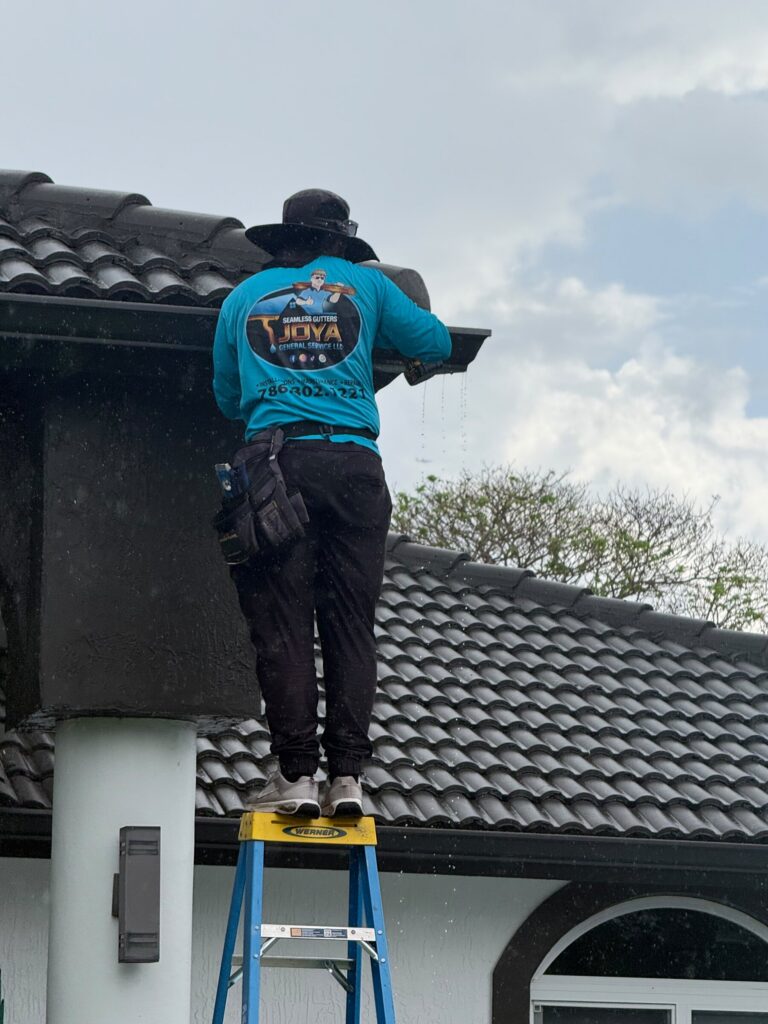
A proper look at a gutter system takes about twenty minutes and covers six things. It is done from a ladder, not from the driveway. If someone quotes you a replacement without going up, they are guessing — and guessing always comes out at “you need a whole new system”.
This is what we check, in the order we check it, so you know what a real inspection looks like and can tell when you are not getting one.
1. The fall
A run should drop about a quarter of an inch for every ten feet so water moves to the outlet instead of standing in the trough.
We check it with a level and, better, with water. Standing water after rain means the fall is wrong or a hanger has let go and the run is sagging. Water sitting in a gutter breeds mosquitoes, adds weight the hangers were not sized for, and leaves the dark tide line you can see from the street.
2. The hangers and the fascia behind them
We check how the run is attached and what it is attached to. Spikes work loose over time, especially in fascia that has been wet. Hidden hangers should be in at about two-foot spacing, tighter on long or exposed runs.
Then we check the board itself. A screw is only as good as the wood holding it, and soft fascia is the single most common thing that turns a repair into a bigger job. We press along the board behind the gutter — if it gives, you need carpentry before you need guttering, and we will say so.
3. The seams and the sealant
On a sectional system, every joint gets checked. Sealant has a service life considerably shorter than the metal it is sealing, and in this climate it cracks, shrinks and lifts at the edges.
On a seamless system there are only corners and outlets to check, which is the point of fitting it. Corners are still the place to look: they take the most movement and they are where almost every seamless leak we find turns out to be.
4. The outlets and the downspouts
We count the outlets against the length of the run and the roof area feeding it, and we check the size of what is fitted — 2×3 or 3×4.
Then we check whether they are clear. The usual blockage is not in the gutter at all; it is in the elbow at the top of the downspout, where the pipe turns and debris stops moving. We flush it and listen. A downspout that gurgles or knocks in heavy rain is telling you there is a restriction in it.
5. Where the water goes after the downspout
This is the step most often skipped and it is the one that causes the expensive damage. We look at where each downspout discharges, how far that is from the wall, and which way the ground slopes once the water lands.
A system can be in perfect condition from the roof to the bottom of the downspout and still be soaking the foundation.
6. The roof edge and the drip line
Last, we look at the relationship between the roof and the gutter: whether the drip edge delivers water into the trough or behind it, whether a steep plane is throwing water clean over the front lip, and whether tiles or shingles at the eave have moved.
We also look at the ground under the drip line. A trench scoured into soil or mulch tells you where the system has been overflowing, even if you have never seen it happen.
What you should get at the end
You should be told three things, plainly: what is wrong, what it will cost to fix, and what is fine and does not need touching. That last one is the test. An inspection that finds every component defective is a sales call.
You should also be told what is urgent and what can wait until next season. Not everything needs doing now, and we would rather schedule the roof-edge repair before the wet season and leave the cosmetic staining for later.
How often
Once a year for most properties here, and twice where there are trees close to the roof — once before the wet season and once after the leaves drop. If a storm has been through, look sooner.
Joya General Services Gutter LLC inspects gutter systems across Opa-locka, Miami and Fort Lauderdale. The look is free. Call (786) 302-1221.