
Tag: Guards

  • Gutter Guards: What They Do and What They Do Not

    Gutter Guards: What They Do and What They Do Not

    Gutter guards are worth fitting on most South Florida properties with trees near the roof. They are not the maintenance-free promise some of the advertising makes them, and a company that tells you that you will never go up a ladder again is selling you something.

    Here is the honest version: what they do, what they do not, and which types are worth the money here.

    What they do

    • Keep leaves, twigs and seed pods out of the trough. This is the main job and a decent guard does it well.
    • Stretch the interval between cleanings. A property that needed clearing three times a year typically goes to once.
    • Stop the trough from becoming a nursery. Mosquitoes breed in standing water held by debris. Less debris, less standing water.
    • Keep birds and rodents out. An open gutter packed with dry material is a nesting site. A screened one is not.
    • Reduce the weight the hangers carry. Wet, packed debris is heavy, and that weight is what pulls runs out of line.

    What they do not

    • They do not eliminate maintenance. Fine material still gets through a mesh, and whatever lands on top of a guard has to be brushed off or it mats and sheds water over the edge.
    • They do not fix a gutter that is the wrong size. If the run overflows because it is undersized or short of outlets, a guard changes nothing — and a badly chosen one makes it worse by narrowing the opening.
    • They do not fix fall. Standing water from a sagging run stays standing under a guard, and you can no longer see it.
    • They do not stop pollen, shingle grit or the fine black sediment that builds into a sludge in the bottom of the trough.
    • They do not survive being walked on. Anyone who puts a ladder against a guarded gutter without knowing what they are doing will deform it.

    The types, and which work here

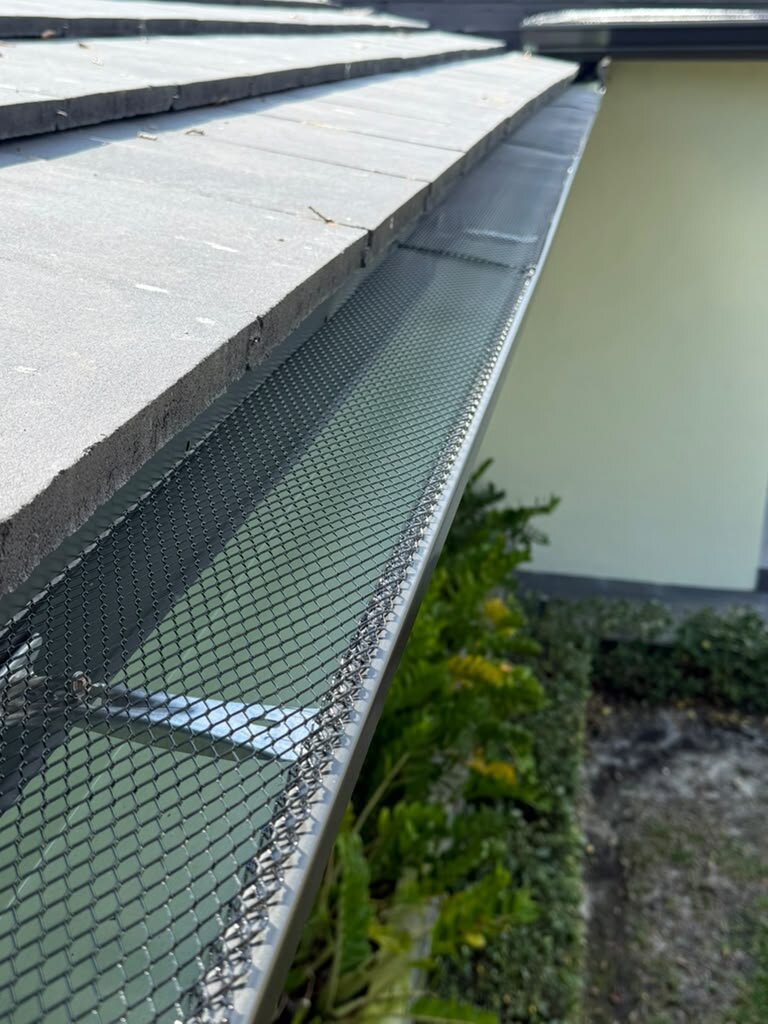
    Aluminium or stainless mesh. A perforated or woven screen over the trough. Good balance of cost and performance, and the type we fit most often. Stainless outlasts aluminium near salt air, which matters on the coast.

    Micro-mesh. A much finer screen, usually stainless on a frame. It stops the small material the standard mesh passes, and it is the best option under pines or anything that drops needles. It costs more and it needs the top brushed off occasionally, because fine mesh is exactly what pollen and dust mat onto.

    Reverse curve, or surface tension. A solid cover with a lip, relying on water clinging around the curve and into a slot while debris falls past. It works in moderate rain. In a two-inch-an-hour storm, a volume of water that is moving fast does not cling to anything — it carries straight over the lip and onto the ground. We do not recommend them here for that reason.

    Foam inserts. A block of foam filling the trough. Cheap, easy, and they degrade in UV, hold moisture against the metal, and eventually grow things. They are a short-term fix sold as a permanent one.

    Brush inserts. A large bottle brush laid in the gutter. Debris collects in the bristles rather than in the trough, which means you still have to pull the brush out to clean it. Marginally better than nothing.

    The South Florida specifics

    Royal palms shed fronds and seed pods that no guard will handle gracefully — a frond lands on top and sits there. If you have palms over the roof, plan on brushing the guards rather than clearing the gutters, and fit 3×4 downspouts so that anything which does get through keeps moving.

    Near the ocean, salt air eats cheap aluminium screen and the steel fasteners holding it. Stainless costs more at fitting and less over ten years.

    And whatever you fit, it has to be installed without lifting the roof edge. Guards that slide up under the first course of shingles or tiles can break the water seal at the eave, which trades a gutter problem for a roof problem. We fit to the gutter, not to the roof.

    Is it worth it

    Run the arithmetic on your own property. If you are paying for three clearings a year, guards typically pay for themselves in two to four years and remove the part of the job you dislike most — the ladder.

    If you have no trees near the roof and you clear the gutters once a year without much trouble, you probably do not need them, and we will tell you that.

    Joya General Services Gutter LLC fits gutter guards across Opa-locka, Miami and Fort Lauderdale. Call (786) 302-1221 and we will look at what is actually landing on your roof before recommending anything.

  • Protectores de canaletas: lo que hacen y lo que no

    Protectores de canaletas: lo que hacen y lo que no

    Los protectores de canaletas valen la pena en la mayoría de las propiedades del sur de la Florida que tienen árboles cerca del techo. No son la promesa de cero mantenimiento que sugiere parte de la publicidad, y la compañía que le diga que nunca más va a subir una escalera le está vendiendo algo.

    Esta es la versión honesta: lo que hacen, lo que no hacen y cuáles tipos valen el dinero aquí.

    Lo que hacen

    • Mantienen hojas, ramitas y semillas fuera del canal. Ese es el trabajo principal y un protector decente lo hace bien.
    • Alargan el intervalo entre limpiezas. Una propiedad que necesitaba limpieza tres veces al año normalmente pasa a una.
    • Evitan que el canal se vuelva un criadero. El mosquito se reproduce en el agua detenida por la basura. Menos basura, menos agua detenida.
    • Dejan fuera a pájaros y roedores. Una canaleta abierta llena de material seco es un sitio de anidación. Una con malla no.
    • Reducen el peso que cargan los soportes. La basura mojada y compactada pesa, y ese peso es lo que saca las corridas de línea.

    Lo que no hacen

    • No eliminan el mantenimiento. El material fino igual pasa la malla, y lo que cae encima del protector hay que barrerlo o se apelmaza y bota el agua por el borde.
    • No arreglan una canaleta del tamaño equivocado. Si la corrida se desborda porque quedó corta o le faltan salidas, el protector no cambia nada — y uno mal escogido lo empeora al estrechar la entrada.
    • No arreglan la caída. El agua parada de una corrida hundida sigue parada debajo del protector, y ahora usted no puede verla.
    • No detienen el polen, el granulado de las shingles ni el sedimento negro fino que se acumula como lodo en el fondo del canal.
    • No aguantan que los pisen. Cualquiera que recueste una escalera sobre una canaleta con protector sin saber lo que hace, la deforma.

    Los tipos, y cuáles sirven aquí

    Malla de aluminio o acero inoxidable. Una pantalla perforada o tejida sobre el canal. Buen equilibrio entre costo y rendimiento, y es el tipo que más instalamos. El inoxidable dura más que el aluminio cerca del aire salino, lo que importa en la costa.

    Micro-malla. Una pantalla mucho más fina, normalmente de inoxidable sobre un marco. Detiene el material pequeño que la malla común deja pasar, y es la mejor opción debajo de pinos o de cualquier cosa que suelte agujas. Cuesta más y hay que barrerle la parte de arriba de vez en cuando, porque una malla fina es exactamente donde se apelmazan el polen y el polvo.

    Curva invertida, o de tensión superficial. Una tapa sólida con un labio, que depende de que el agua se adhiera a la curva y entre por una ranura mientras la basura cae de largo. Funciona con lluvia moderada. En una tormenta de dos pulgadas por hora, un volumen de agua que va rápido no se adhiere a nada — pasa derecho por encima del labio y cae al suelo. Por eso no los recomendamos aquí.

    Insertos de espuma. Un bloque de espuma que llena el canal. Baratos, fáciles, y se degradan con el sol, retienen humedad contra el metal y con el tiempo les crece cosa adentro. Son un arreglo temporal vendido como permanente.

    Insertos de cepillo. Un cepillo grande acostado dentro de la canaleta. La basura se junta en las cerdas en vez de en el canal, lo que significa que igual hay que sacar el cepillo para limpiarlo. Apenas mejor que nada.

    Lo específico del sur de la Florida

    Las palmas reales sueltan pencas y racimos de semillas que ningún protector maneja con elegancia — una penca cae encima y ahí se queda. Si tiene palmas sobre el techo, cuente con barrer los protectores en vez de limpiar las canaletas, e instale bajantes de 3×4 para que lo que sí pase siga moviéndose.

    Cerca del mar, el aire salino se come la malla de aluminio barata y los tornillos de acero que la sujetan. El inoxidable cuesta más al instalar y menos a diez años.

    Y sea cual sea el que instale, tiene que ponerse sin levantar el borde del techo. Los protectores que se meten por debajo de la primera hilera de shingles o tejas pueden romper el sello de agua del alero, lo que cambia un problema de canaleta por un problema de techo. Nosotros fijamos a la canaleta, no al techo.

    ¿Vale la pena?

    Saque la cuenta en su propia propiedad. Si está pagando tres limpiezas al año, los protectores normalmente se pagan solos en dos a cuatro años y le quitan la parte del trabajo que menos le gusta: la escalera.

    Si no tiene árboles cerca del techo y limpia las canaletas una vez al año sin mucho problema, probablemente no los necesita, y se lo vamos a decir.

    Joya General Services Gutter LLC instala protectores de canaletas en Opa-locka, Miami y Fort Lauderdale. Llame al (786) 302-1221 y vamos a ver qué está cayendo de verdad sobre su techo antes de recomendarle nada.