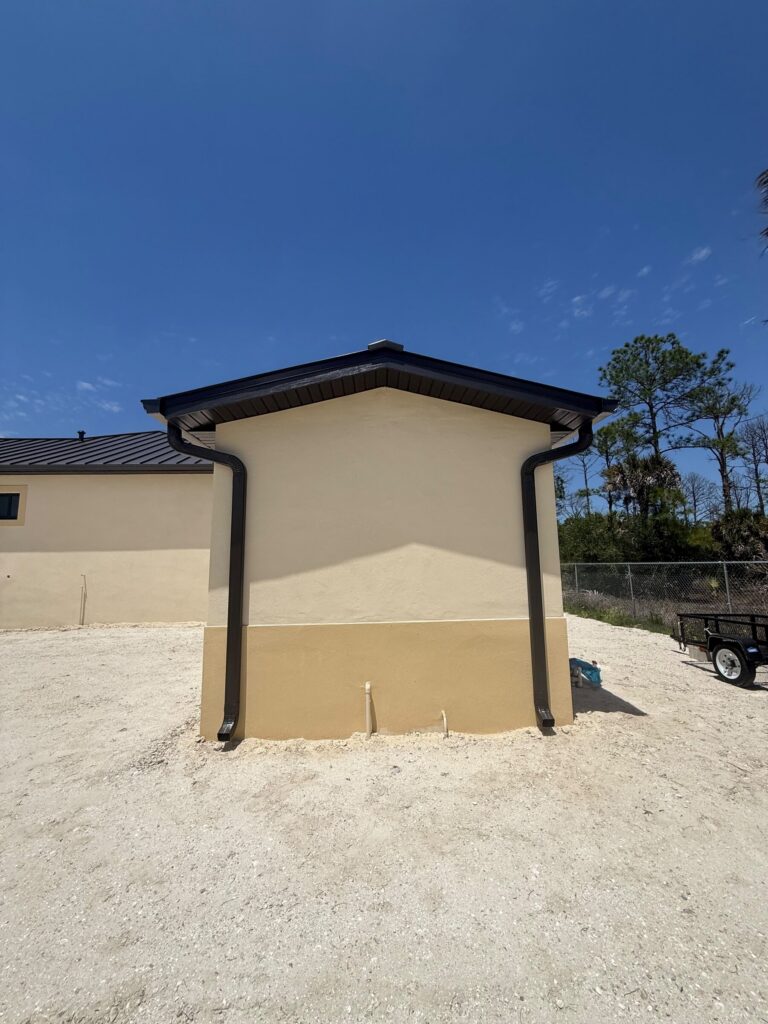
A gutter only moves water sideways. The downspout is the part that takes it down and away from the building, and on most of the houses we are called out to, the gutter is fine and the downspouts are the problem.
They are also the cheapest part of the system to get right. Adding an outlet costs a fraction of replacing a run, and it solves more complaints than any other single change we make.
How many outlets a run actually needs
The working rule is one downspout for roughly every 30 to 40 feet of gutter, and fewer than that where the roof feeding the run is large or steep. Long runs with a single outlet at one end are common on older houses here, usually because the original builder was counting corners rather than water.
What happens is predictable. Water entering at the far end has to travel the entire length before it can leave, the trough fills faster than the one outlet can drain it, and the excess goes over the front lip somewhere in the middle. People see water pouring off the centre of a run and assume the gutter is blocked. Often it is simply outnumbered.
Two by three, or three by four
The standard residential downspout is 2×3 inches. The larger size is 3×4, and it moves substantially more water — close to double, in practice, because the bigger cross-section is also far less prone to jamming.
That second point matters more than the arithmetic. A 2×3 outlet is narrow enough that a single palm frond, a tennis ball, or a season of seed pods can choke it. A 3×4 passes the same debris without stopping. On any property with trees close to the roof, we fit the larger size as a matter of course.
Where the water lands is half the job
A downspout that discharges at the base of the wall has moved the problem four feet, not solved it. The water now soaks into the ground directly against the foundation, which is the exact place you were trying to keep it away from.
What the discharge point should do:
- Carry water clear of the structure. Four to six feet is a reasonable minimum, further on a slab that sits low.
- Release onto something that drains. Turf, gravel, a splash block — not bare soil that will wash out into a trench within a season.
- Run away from the house, not along it. Grade matters. We check it with a level, because eyes are unreliable on a flat lot.
- Keep clear of walkways. Water across a path is an algae problem and, eventually, somebody’s fall.
Where there is no room for a surface extension — a narrow side yard, a paved path tight to the wall — the answer is usually a buried line running out to a pop-up emitter in the lawn. It costs more than an elbow and a splash block, and it is the right fix on a tight lot.
Signs yours are undersized or wrongly placed
- Water overshooting the middle of a run while the ends stay dry.
- A gurgle or a knock from the downspout in heavy rain — air trapped behind a restriction.
- A fan of soil or mulch washed away under the outlet.
- A permanent damp patch on the stucco below the discharge point.
- Water standing against the slab for hours after the rain has stopped.
- Dark staining down the outside of the downspout itself, which means it is overflowing at a joint.
The part that costs money later
Water repeatedly soaking the ground against a slab does not announce itself. It shows up as a hairline crack that was not there last year, as a door that stops closing cleanly, as efflorescence — that white powder — on the inside face of a wall.
Those are expensive to chase and cheap to prevent. A correctly sized outlet and a six-foot extension are a morning’s work.
What we check
When we look at a property we count the outlets against the length and the catchment area of each run, check the size of what is fitted, look at where every downspout actually discharges, and test the grade away from the wall. Then we tell you which ones need moving, which need upsizing, and which are fine as they are.
Often the recommendation is to add one outlet. We would rather say that than sell you a new system you do not need.
Joya General Services Gutter LLC fits and repairs downspouts and drainage across Opa-locka, Miami and Fort Lauderdale. Call (786) 302-1221 and we will come and look at no charge.